Model analysis / September 8, 2026 / 10 min read
Qwen 3.8 27B: The Practical Sweet Spot for Local AI
Why a dense 27-billion-parameter model with native MTP, deep context, and high quantization precision punches far above its weight on local hardware.
On this page
- Benchmark Reality: Trading Blows with Frontier Giants
- Native Multi-Token Prediction (MTP) Explained
- Firsthand Daily Driver Setup
- Weights vs. KV-Cache Quantization
- Earlier Q6 Context Sharing with Parallel Slots
- Firsthand Reasoning Dynamics: Overthinking and Recovery
- Navigating Guardrails: Uncensored Variants
- Dual RTX 3090 Q4_K_M Benchmarks
- Why 27B Is the Practical Champion
- See Also
In mid-August 2026, Alibaba released Qwen3.8-27B, an open-weight dense vision-language model published under Apache 2.0.
While public headlines focused on the 2.4-trillion-parameter Qwen3.8-Max API, the open 27B checkpoint is the most practical for local inference. Compact 8B and 14B models run fast but stumble on complex logic, while 400B+ models demand multi-GPU server clusters or aggressive quantization. The 27B scale hits the sweet spot, pairing native multi-token prediction (MTP) with deep context on accessible hardware.
Benchmark Reality: Trading Blows with Frontier Giants
On independent benchmarks, Qwen3.8-27B performs well beyond typical 27B expectations.
Artificial Analysis currently gives the model’s xhigh reasoning setting a score of 34 on its Intelligence Index. That score does not put it level with every frontier API model, but it is extremely strong for a small dense 27B model.
The more striking comparisons come from Qwen’s own published tests. Qwen3.8-27B scored 61.7 on SWE-bench Pro, against 57.6 for the 397B Qwen3.7-Plus, and 42.2 on DeepSWE 1.1, against 14.2 for that larger model. Vendor benchmark discretion required, but they support the central point: this 27B model can trade blows with models around 5-10x its size on some coding tasks.
A 3:1 hybrid attention design combines Gated DeltaNet linear attention with full attention. This reduces the cost of long contexts while retaining periodic full-attention layers. The official weights are hosted at Qwen/Qwen3.8-27B, with a hosted endpoint on OpenRouter under qwen/qwen3.8-27b. Native context spans 262,144 tokens (256K), extensible to 1M with YaRN scaling.
Native Multi-Token Prediction (MTP) Explained
A major technical advantage of Qwen3.8-27B is native Multi-Token Prediction (MTP).
Standard LLMs generate text token by token, bottlenecked by memory bandwidth as weights stream repeatedly from VRAM. Speculative decoding and MTP overcome this by predicting several future tokens and validating them together in one pass.
Unlike traditional speculative setups that require loading a secondary draft model, Qwen3.8-27B embeds auxiliary MTP prediction heads directly into the model checkpoint. In engines like llama.cpp and vLLM, these heads propose upcoming tokens simultaneously, and the base network verifies them in parallel on the next forward pass.
Firsthand Daily Driver Setup
Qwen3.8-27B is my daily driver for software development and automated workspace tasks. The testbed is an open-frame workstation with two 24 GB NVIDIA GeForce RTX 3090 cards (48 GB total VRAM) on an ASRock WRX80 motherboard.
For the physical build, see my dual RTX 3090 workstation guide and RTX 3090 for local AI inference.
Earlier Q6 Daily-Driver Configuration
| Setting | Observed Value | Rationale |
|---|---|---|
| Model Checkpoint | Qwen3.8-27B (GGUF) | Dense 27B reasoning architecture |
| Weight Precision | Q6_K | ~23 GB footprint; no visible quality loss vs tested Q8 |
| KV Cache Precision | Q8_0 | Chosen for peace of mind across deep context |
| Total Context Allocation | ~393,216 tokens (~393K) | Fills remaining ~25 GB of VRAM across both cards |
| Parallel Request Slots | 2 (-np 2) |
Splits pool into two concurrent 196K token streams |
| Decode Speeds | 60–80 tok/s short, 25–30 tok/s deep | Observed with native MTP on 2x RTX 3090 |
| Hardware | 2x RTX 3090 (48 GB VRAM) | Bandwidth-matched local workstation |
To project memory requirements and speeds for your own GPUs, test your target numbers in the local AI token speed and memory calculator.
Weights vs. KV-Cache Quantization
Running a 27B model with deep context on 48 GB VRAM requires separating static weights from the dynamic KV cache.
I initially ran full Q8_0 weights, which occupied roughly 29 GB and left only 19 GB for context. Dropping to Q6_K weights freed about 6 GB (down to ~23 GB) with no visible quality loss in my daily coding and reasoning.
I kept the KV cache at Q8_0 for peace of mind during long-context retrieval. Using Q6_K weights and a Q8_0 cache gives me an effective balance of compact storage and reliable recall. For quantization fundamentals, see my beginner’s guide to LLM quantization.
Earlier Q6 Context Sharing with Parallel Slots
With Q6_K weights using about 23 GB, roughly 25 GB of VRAM remains for the KV cache, fitting approximately 393,216 total tokens (~393K) at Q8_0.
Configuring parallel slots in llama.cpp makes this capacity much more productive:
llama-server \
  -m Qwen3.8-27B-Q6_K.gguf \
  -c 393216 \
  -np 2 \
  -ctk q8_0 \
  -ctv q8_0 \
  --spec-type draft-mtp
At the time, -np 2 split the pool into two 196K token streams. Both slots served interactive coding, usually when I was working in different repositories or had an ongoing background task. They shared the same 23 GB weight block in memory and ran concurrently without model reloads.
Firsthand Reasoning Dynamics: Overthinking and Recovery
Qwen3.8-27B includes a native thinking mode that generates reasoning tokens before responding (detailed in reasoning models and thinking tokens explained).
In daily use, it characteristically overthinks. On complex tasks, it frequently explores edge cases, challenges assumptions, and occasionally wanders into circular reasoning.
Crucially, if left running, the model frequently recovers on its own. Unlike smaller models that remain broken once confused, Qwen3.8-27B often catches mistakes mid-stream (“Wait, that assumption contradicts the initial logic…”), discards the dead end, and reaches the correct solution. Letting it finish rather than interrupting usually yields the best result.
Navigating Guardrails: Uncensored Variants
In earlier iterations like Qwen 3.5 and 3.6, aligned models often spent frustrating thinking tokens considering guardrails on ordinary technical questions. When asking the model to parse benign code or discuss system internals, the reasoning phase frequently burned tokens debating safety policies before answering.
Abliterated releases reduce this behavior by changing the refusal-related directions in the model’s weights.
In my testing, I have used uncensored builds from OrcaRouter and dealignai. The Hugging Face releases include orcarouter/Qwen3.8-27B-Uncensored, chimingw/Qwen3.8-27B-Uncensored-OrcaRouter-GGUF, and dealignai/Qwen3.8-27B-UNCENSORED-GGUF.
Dual RTX 3090 Q4_K_M Benchmarks
I reran Qwen3.8-27B using the dealignai Q4_K_M GGUF on both RTX 3090s. The 17,010,517,600-byte model remained entirely GPU-resident. Both cards were limited to 250 W, with a 1:1 tensor split, Q8_0 K/V caches, Flash Attention, and 2,048-token batch and micro-batch sizes.
The conventional context and concurrency measurements used llama-bench and llama-batched-bench build 476. Each reported value is the arithmetic mean of three measured runs after warm-up. Prompt processing used 512 tokens and generation used 256 tokens.
Prompt Processing and Non-MTP Decode
| KV depth | Prompt Processing | Token Generation |
|---|---|---|
| 0 | 1,550.49 t/s | 58.45 t/s |
| 2,048 | 1,501.02 t/s | 57.96 t/s |
| 4,096 | 1,487.12 t/s | 57.31 t/s |
| 8,192 | 1,441.90 t/s | 55.69 t/s |
| 16,384 | 1,359.20 t/s | 53.57 t/s |
| 32,768 | 1,233.63 t/s | 49.66 t/s |
| 65,536 | 1,032.98 t/s | 42.83 t/s |
| 131,072 | 774.93 t/s | 33.45 t/s |
| 262,144 | 512.93 t/s | 22.68 t/s |
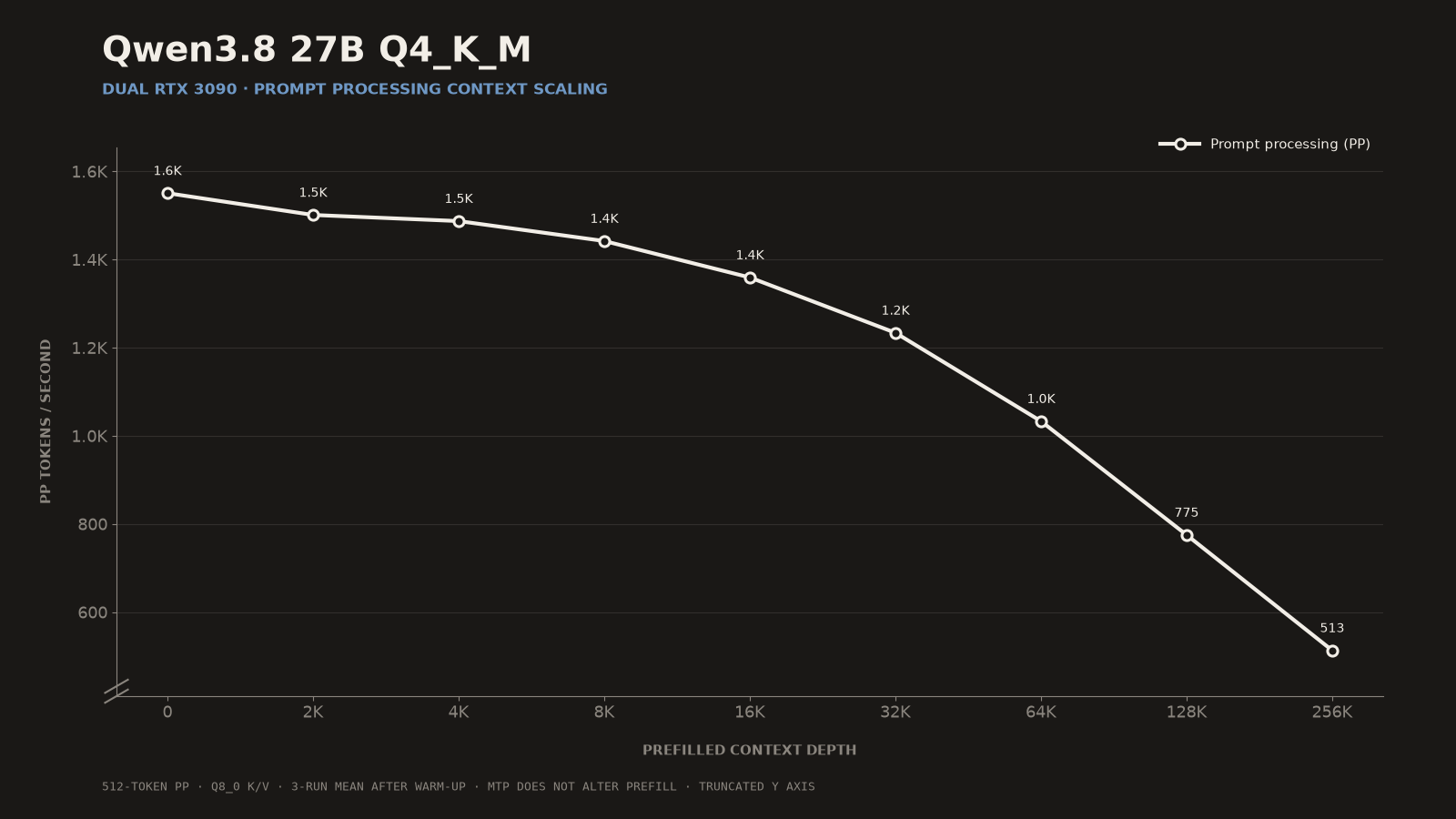
With an empty cache, prompt processing reached 1,550.49 tok/s and non-MTP generation reached 58.45 tok/s. At 128K depth those rates were 774.93 tok/s and 33.45 tok/s; at 256K they were 512.93 tok/s and 22.68 tok/s.
Native MTP Across Context
I then exercised the embedded MTP head through a live llama-server build 50. Draft maximums of two, three, and four were tested at every depth. Draft max two was the most consistent setting and is the one I now use for serving.
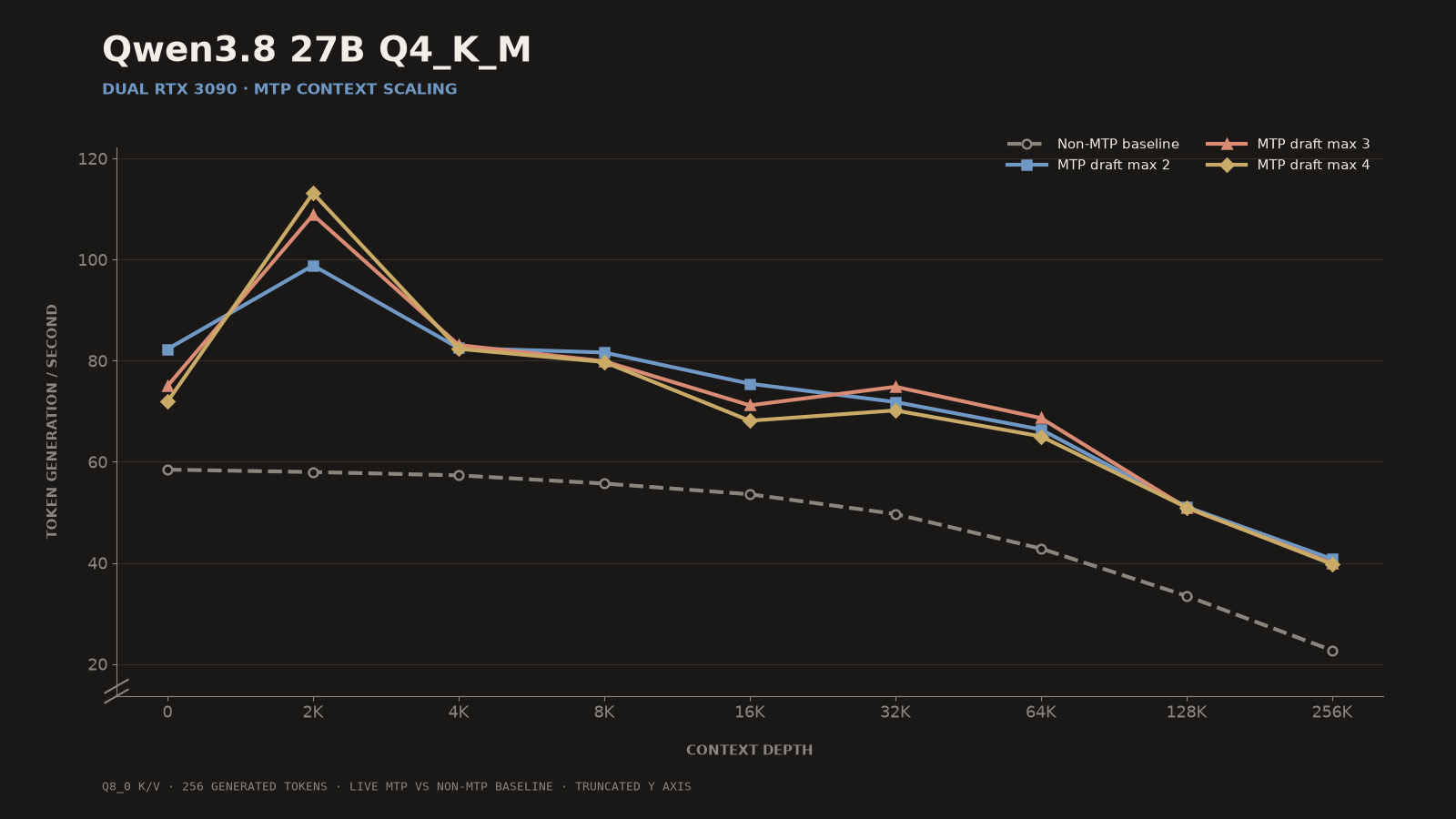
Draft max two generated 82.27 tok/s at shallow context, 66.38 tok/s at 64K, 51.08 tok/s at 128K, and 40.75 tok/s near the full native 256K window. At the deepest point, the prompt contained 261,888 tokens and left exactly 256 tokens for measured generation.
| Model / mode | Context tokens | PP | TG |
|---|---|---|---|
| Qwen3.8 27B Q4_K_M · MTP draft 2 | 12 | — | 82.27 |
| Qwen3.8 27B Q4_K_M · MTP draft 2 | 2,048 | — | 98.83 |
| Qwen3.8 27B Q4_K_M · MTP draft 2 | 4,096 | — | 82.49 |
| Qwen3.8 27B Q4_K_M · MTP draft 2 | 8,192 | — | 81.62 |
| Qwen3.8 27B Q4_K_M · MTP draft 2 | 16,384 | — | 75.44 |
| Qwen3.8 27B Q4_K_M · MTP draft 2 | 32,768 | — | 71.82 |
| Qwen3.8 27B Q4_K_M · MTP draft 2 | 65,536 | — | 66.38 |
| Qwen3.8 27B Q4_K_M · MTP draft 2 | 131,072 | — | 51.08 |
| Qwen3.8 27B Q4_K_M · MTP draft 2 | 261,888 | — | 40.75 |
| Qwen3.8 27B Q4_K_M · MTP draft 3 | 12 | — | 74.98 |
| Qwen3.8 27B Q4_K_M · MTP draft 3 | 2,048 | — | 108.82 |
| Qwen3.8 27B Q4_K_M · MTP draft 3 | 4,096 | — | 83.09 |
| Qwen3.8 27B Q4_K_M · MTP draft 3 | 8,192 | — | 79.89 |
| Qwen3.8 27B Q4_K_M · MTP draft 3 | 16,384 | — | 71.16 |
| Qwen3.8 27B Q4_K_M · MTP draft 3 | 32,768 | — | 74.83 |
| Qwen3.8 27B Q4_K_M · MTP draft 3 | 65,536 | — | 68.63 |
| Qwen3.8 27B Q4_K_M · MTP draft 3 | 131,072 | — | 50.87 |
| Qwen3.8 27B Q4_K_M · MTP draft 3 | 261,888 | — | 39.91 |
| Qwen3.8 27B Q4_K_M · MTP draft 4 | 12 | — | 71.87 |
| Qwen3.8 27B Q4_K_M · MTP draft 4 | 2,048 | — | 113.13 |
| Qwen3.8 27B Q4_K_M · MTP draft 4 | 4,096 | — | 82.33 |
| Qwen3.8 27B Q4_K_M · MTP draft 4 | 8,192 | — | 79.72 |
| Qwen3.8 27B Q4_K_M · MTP draft 4 | 16,384 | — | 68.12 |
| Qwen3.8 27B Q4_K_M · MTP draft 4 | 32,768 | — | 70.15 |
| Qwen3.8 27B Q4_K_M · MTP draft 4 | 65,536 | — | 65.02 |
| Qwen3.8 27B Q4_K_M · MTP draft 4 | 131,072 | — | 50.95 |
| Qwen3.8 27B Q4_K_M · MTP draft 4 | 261,888 | — | 39.72 |
These rows are imported from the preserved live-server measurements, not a new benchmark run. PP was not measured by this MTP protocol and is left blank. Draft max five was not part of this historical run.
Draft Acceptance
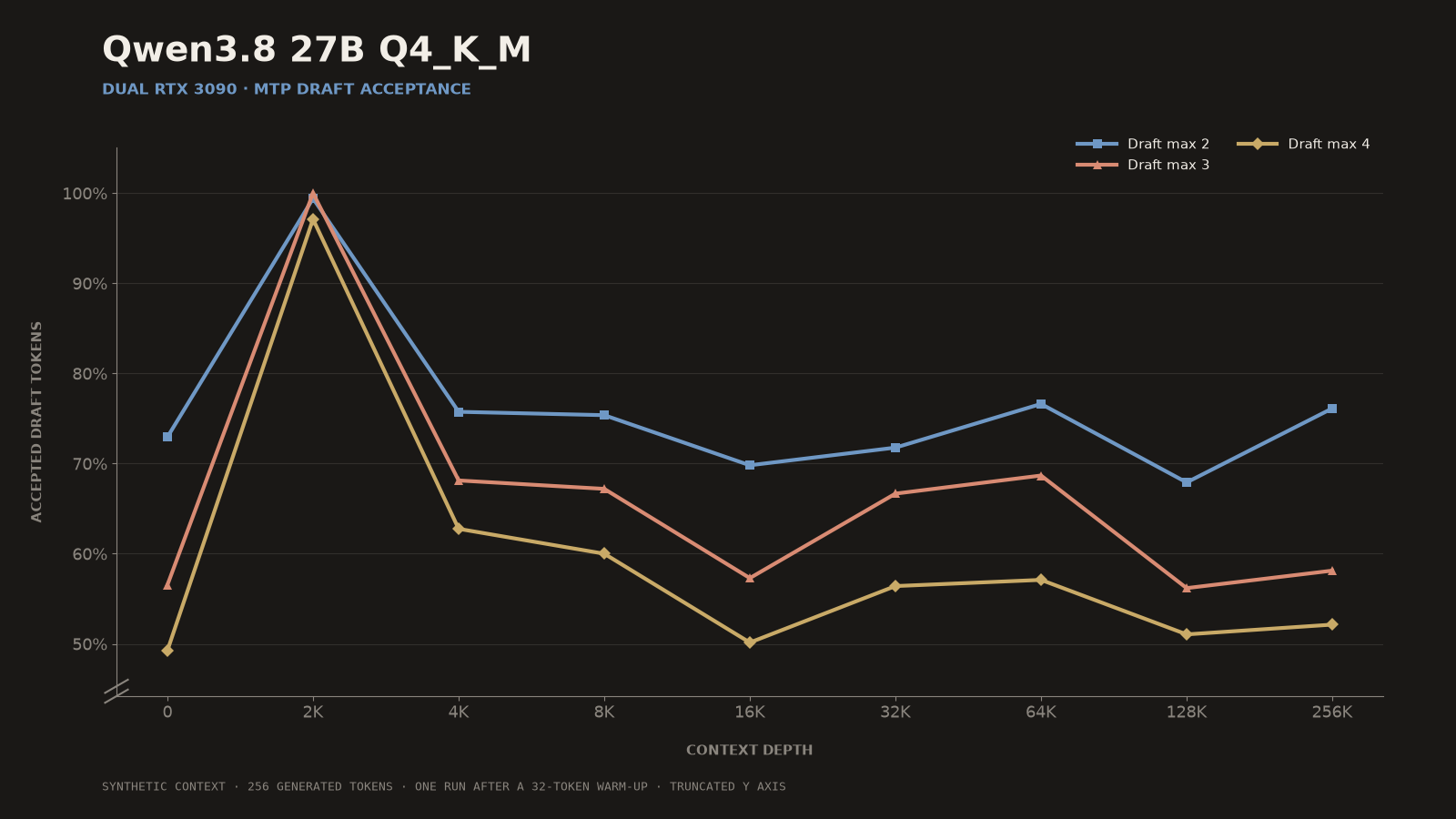
The live MTP sweep used deterministic synthetic repeated-token context, one measured 256-token completion after a 32-token warm-up, temperature zero, and a fixed seed. The unusually high acceptance around 2K reflects that synthetic prompt and should not be generalized to ordinary prose or code. The 128K and 256K responses were identical across all three draft settings, making those high-context comparisons cleaner, but a representative prompt corpus would still provide stronger evidence.
Concurrent Throughput
| Model / mode | KV depth | Streams | Agg. PP | Agg. TG | TG / stream | Agg. all |
|---|---|---|---|---|---|---|
| Qwen3.8 27B Q4_K_M · Standard (no MTP) | 8K | 2 | 1,566.7 | 95.02 | 47.51 | 254.23 |
| Qwen3.8 27B Q4_K_M · Standard (no MTP) | 8K | 3 | 1,604.7 | 115.28 | 38.43 | 302.39 |
| Qwen3.8 27B Q4_K_M · Standard (no MTP) | 8K | 4 | 1,611.1 | 129.08 | 32.27 | 333.76 |
| Qwen3.8 27B Q4_K_M · Standard (no MTP) | 8K | 5 | 1,588.2 | 141.75 | 28.35 | 360.83 |
| Qwen3.8 27B Q4_K_M · Standard (no MTP) | 8K | 6 | 1,607.8 | 146.12 | 24.35 | 370.94 |
| Qwen3.8 27B Q4_K_M · Standard (no MTP) | 8K | 8 | 1,625.9 | 158.16 | 19.77 | 397.20 |
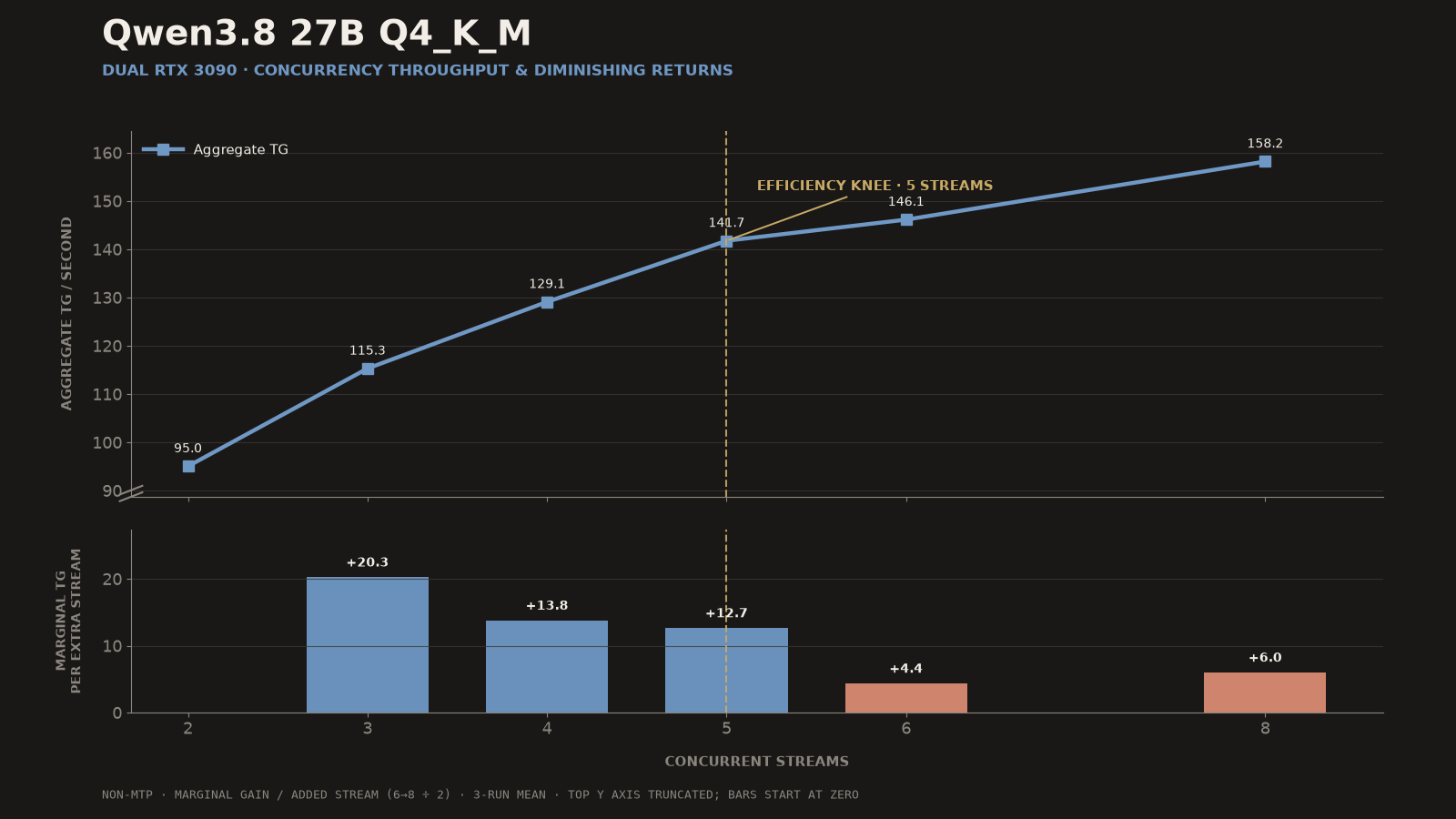
Aggregate non-MTP generation increased from 95.02 tok/s with two streams to 158.16 tok/s with eight. The throughput-efficiency knee was five streams: it delivered 141.75 tok/s, while each of the next three streams added an average of only 5.47 tok/s. Eight streams maximize measured aggregate output, but five provide the better balance when individual response speed matters.
Maximum Context Fit
With the multimodal projector loaded, a two-slot server successfully allocated 507,904 total tokens, or 253,952 tokens per slot. A 509,952-token allocation failed with a CUDA out-of-memory error. The current four-slot serving configuration retains the 507,904-token pool and divides it into 126,976 tokens per slot.
This total allocation exceeds the model’s native 262,144-token context because it is a shared server pool, not one request window. Each request must remain within the model’s native limit unless YaRN scaling is deliberately enabled.
Methodology Caveat
The non-MTP rows use llama-bench build 476 with three repetitions. The MTP rows use live llama-server build 50 with one measured repetition after warm-up and synthetic context. Individual measured rates are useful operational reference points; percentage differences between those two paths should not be presented as a controlled MTP speedup experiment. Raw commands, logs, JSON responses, manifests, and the combined reference file are preserved with the benchmark dataset.
Why 27B Is the Practical Champion
Qwen3.8-27B proves why 27B is the sweet spot:
- Clean Hardware Fit: At Q4_K_M, the model remains fully GPU-resident on two 24 GB cards while leaving enough VRAM for a measured 507,904-token Q8 cache pool. The current four-slot configuration provides 126,976 tokens per request.
- Built-in Speculative Speed: Integrated MTP heads accelerate generation without a separate draft model.
- Frontier Reasoning: On independent benchmarks, it trades blows with huge MOEs while solving complex programming and agent tasks that smaller models struggle to complete.
For a local workstation daily driver, Qwen3.8-27B delivers an outstanding combination of speed, deep context, and reasoning capability.
See Also
- Speculative Decoding and MTP Explained — draft heads and multi-token prediction
- Reasoning Models and Thinking Tokens Explained — chains of thought and thinking budgets
- Beginner’s Guide to LLM Quantization — GGUF formats and precision trade-offs
- My Dual RTX 3090 Local AI Workstation — complete hardware setup and power management
- RTX 3090 for Local AI Inference — memory bandwidth and multi-GPU scaling
- Best GPUs and Devices for Local AI — discrete cards and unified memory platforms
- Token Speed and Memory Fit Calculator — test memory footprints and decode speeds