local-ai / July 20, 2026 / 10 min read
The Best Affordable Multi-GPU Motherboard for Local AI
WRX80 is the affordable way to run several GPUs but UK motherboard prices have become harder to justify than the CPUs.
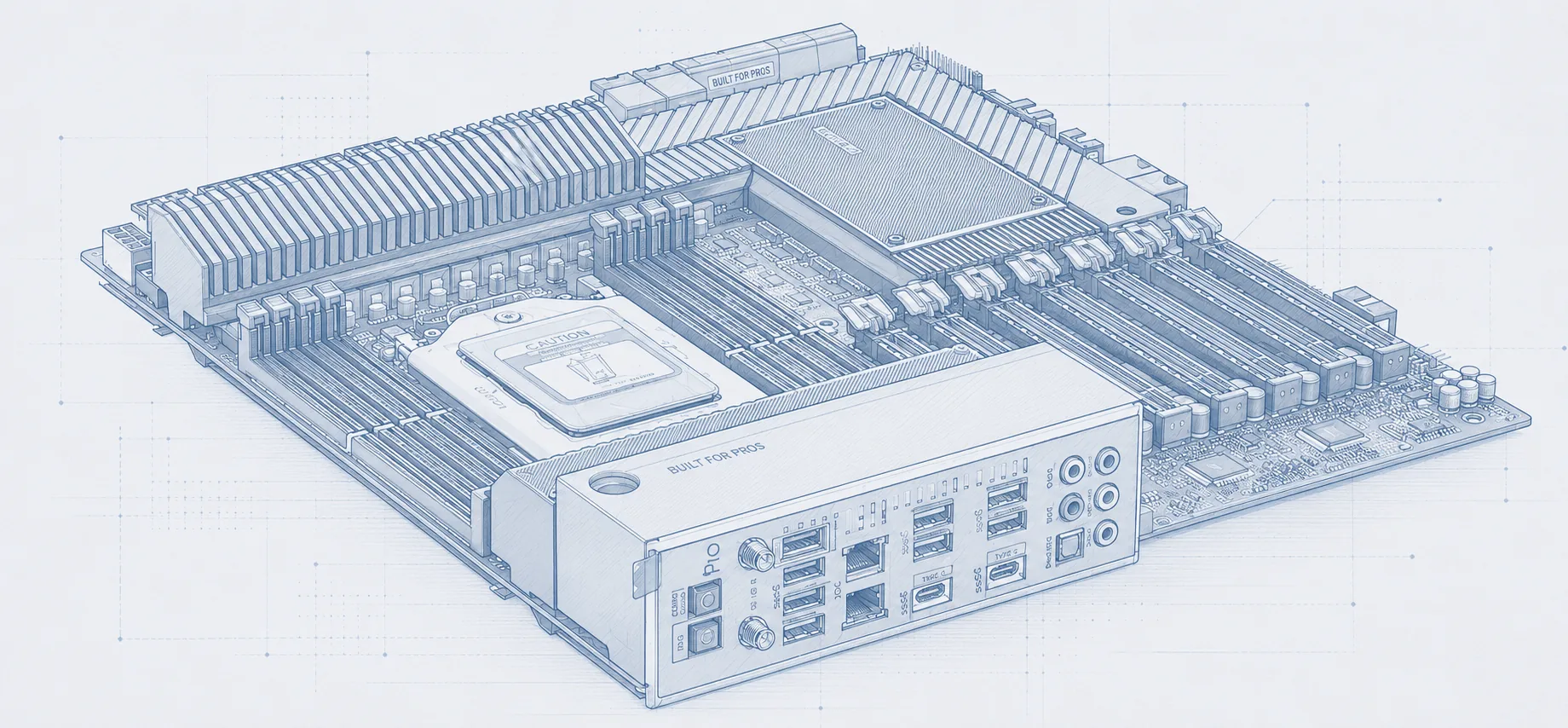
Building a 4 or 8 GPU local AI machine sounds easy until you look for a motherboard. Used GPUs are almost everywhere, older server CPUs have collapsed in value, and DDR4 is much cheaper than current DDR5. The awkward part is finding the board with enough PCIe slots without paying more than the processor and memory combined.
WRX80 is the cleanest answer. It gives Threadripper Pro 3000WX and 5000WX processors 128 PCIe 4.0 lanes, eight channels of DDR4, ECC RDIMM support, and workstation boards designed for several full-size cards. The usual recommendation is the ASUS Pro WS WRX80E-SAGE SE WIFI.
It is a great board. It is also regularly advertised around £850–£1,100 used in the UK, with current active asks reaching about £1,190. These boards were closer to £500–£600 before local AI demand met a wave of cheap Threadripper Pro CPUs.
Why WRX80 fits multi-GPU builds
All four Threadripper Pro 3000WX processors provide the same basic platform resources:
- 128 PCIe 4.0 lanes from the CPU, with eight used for the chipset link;
- eight DDR4-3200 memory channels;
- a theoretical memory ceiling of 204.8 GB/s;
- ECC UDIMM, RDIMM and LRDIMM support, depending on the board;
- up to 2 TB of memory on the original WRX80 generation;
- a 280 W CPU power envelope.
Storage, networking and the chipset will consume some of the PCIe lanes but a well-designed WRX80 board can run seven physical x16 slots without the compromises found on ordinary desktop platforms.
For inference, every GPU does not always need a full x16 link. Once a model shard is loaded, a workload with limited cross-GPU traffic may run well over PCIe 4.0 x8. Starting with enough direct CPU lanes keeps options open instead of forcing four expensive GPUs through a consumer chipset.
The three WRX80 boards worth knowing
ASUS Pro WS WRX80E-SAGE SE WIFI
The ASUS is the default recommendation for good reason. It has seven PCIe 4.0 x16 slots, eight DIMM slots, three M.2 sockets, dual 10GbE, and an ASMB9-iKVM management controller (Proper remote console and power management). The board also includes extra PCIe power connectors for dense accelerator configurations.
It is an complete workstation board and its slot layout is friendly to risers, water blocks and narrow blower cards. ASUS officially supports up to 2 TB of DDR4 across eight channels. The downside is scarcity.
I once paid for a WRX80E-SAGE and Threadripper Pro bundle for under £900. It was not a ridiculous once-in-a-lifetime bargain, but it was fair and these boards rarely appear. The seller could not find the right packaging and didn’t want to risk postage damage so they changed the sale to collection only. The journey was too far, so I passed. In hindsight, that was the last uncomplicated WRX80 option I found.
Official specifications: ASUS Pro WS WRX80E-SAGE SE WIFI.
Gigabyte MC62-G40
The Gigabyte MC62-G40 is the board I looked for next. It is less famous than the ASUS but follows the same useful formula: WRX80, eight DDR4 channels, seven PCIe 4.0 x16 slots and server-style remote management. It looks more like an OEM workstation board than a premium desktop product, which is fine for a machine that will spend its life holding GPUs.
Chinese eBay sellers were advertising boards around £500–£700, so I bought the cheapest one. The seller did not actually have it. They planned to source a board after the order and quoted up to 21 days before dispatch. I’m impatient so I’d rather try my luck elsewhere.
I went to Alibaba, though i suspect 99% of them are resellers, and I contacted roughly 15 sellers and found that the used or decommissioned stock had largely dried up. Most could only offer new boards in retail packaging. Several said the MC62-G40 had previously sold around $400, but demand had risen sharply. Cheap Threadripper Pro CPUs and local AI are the obvious explanation, although it is difficult to separate genuine demand from sellers repeating the same story.
The July 2026 eBay UK asking-price snapshot is worse than the £500–£700 range. Standalone MC62-G40 listings cluster around £723–£829, mostly from overseas sellers. A board with a 3945WX starts around £1,020. At that point the Gigabyte is still cheaper than many ASUS listings, but it is no longer a hidden bargain.
Official product page: Gigabyte MC62-G40.
Supermicro M12SWA-TF
The Supermicro M12SWA-TF is the third proper WRX80 option. It supports eight-channel DDR4-3200, remote IPMI management, onboard 10GbE and six PCIe 4.0 x16 slots. Supermicro’s firmware and management tools are familiar to server users, but the board is less common in workstation discussions and was even harder to find in the UK.
Current marketplace results are thin: I found a retail board advertised around £849, with US asks near $1,200–$1,300. It becomes attractive if a decommissioned workstation appears locally, but there is not enough regular UK supply to plan a build around it.
Official product page: Supermicro M12SWA-TF.
Current UK asking prices
These are active eBay asking prices checked on 20 July 2026 through PicClick’s UK marketplace index, not completed-sale averages. Rare hardware has optimistic listings that can sit for months, and imported prices may exclude some combination of VAT, duty or handling fees.
| Platform or part | Current asking-price range | What I would pay attention to |
|---|---|---|
| ASUS WRX80E-SAGE SE WIFI | Roughly £850–£1,190 | Best all-round WRX80 board; local used listings are rare |
| Gigabyte MC62-G40 | Roughly £723–£829 | Many listings are imported; confirm the seller physically has it |
| MC62-G40 + 3945WX | From roughly £1,020 | Better than buying an overpriced CPU separately, but check vendor lock |
| Supermicro M12SWA-TF | Around £849 | Sparse supply; six x16 slots rather than seven |
Marketplace references: WRX80E-SAGE listings, MC62-G40 listings, M12SWA-TF listings
The cheap Threadripper Pro CPUs
The strange WRX80 market makes more sense when you see the processor prices. A 3945WX is currently advertised from about £87–£100, while an unlocked 3955WX starts around £200. Those processors are more than adequate as hosts for GPU-heavy inference. The 3975WX and 3995WX cost much more, but they also change the CPU-offload calculation.
| CPU | Cores / threads | Base / boost | L3 cache | CCDs | TDP | eBay UK asking price |
|---|---|---|---|---|---|---|
| Threadripper Pro 3945WX | 12 / 24 | 4.0 / 4.3 GHz | 64 MB | 2 | 280 W | From about £87–£100 |
| Threadripper Pro 3955WX | 16 / 32 | 3.9 / 4.3 GHz | 64 MB | 2 | 280 W | From about £200 |
| Threadripper Pro 3975WX | 32 / 64 | 3.5 / 4.2 GHz | 128 MB | 4 | 280 W | Roughly £550–£720 |
| Threadripper Pro 3995WX | 64 / 128 | 2.7 / 4.2 GHz | 256 MB | 8 | 280 W | Roughly £800–£1,250 |
All four have 128 PCIe 4.0 lanes and an eight-channel DDR4-3200 controller rated at 204.8 GB/s in theory. They do not have the same ability to use that memory bandwidth in CPU-heavy work.
The 3945WX and 3955WX contain only two core chiplets (CCDs). The 3975WX has four and the 3995WX has eight. Eight memory channels still work with a two-CCD processor, but a small number of cores and Infinity Fabric links may not generate enough concurrent traffic to reach the platform’s theoretical limit. STREAM-style bandwidth, NUMA behaviour and llama.cpp CPU-offload speed improve with more CCDs and cores.
If most of the model stays in VRAM then the cheap 3945WX is perfectly sensible. If a large fraction of each token is computed from system RAM, the CPU matters. The 3975WX or a suitable EPYC can make better use of a large eight-channel memory population.
Check vendor lock before buying any cheap workstation or server CPU. Lenovo and Dell used AMD’s platform secure-boot features on some systems, and marketplace listings mix locked and unlocked parts.
CPU references: Threadripper processor specifications and CCD layouts and current 3945WX / 3955WX listings.
Taobao was the workable WRX80 route
After eBay and Alibaba failed, I ended up on Taobao through a purchasing agent. Used and decommissioned WRX80 boards were listed around ¥4,000–¥6,000. At the 20 July exchange rate, that is roughly £439–£659 before the agent, domestic Chinese shipping, international freight, VAT/customs (Agents allow you to declare any price you like on your package and as an upstanding citizen you should be completely honest, you do belong to the state after all).
The total is not magically cheap, but it can still land 30–40% below a comparable UK purchase depending on the board and shipping method. More importantly, the listings represented actual used stock rather than a seller promising to find a board after taking payment.
An agent adds friction but also gives you a chance to request photos, socket inspection, etc. I used a general agent who didnt specialise in computer hardware so they couldnt power on, but the board looked good enough so i YOLOed it.
TRX40 is a cheaper compromise
TRX40 uses the non-Pro 3960X, 3970X and 3990X processors. AMD lists 88 PCIe 4.0 platform lanes in total, of which 64 originate from the CPU, and quad-channel DDR4 with a theoretical ceiling of 102.4 GB/s at DDR4-3200.
That is still enough for a serious multi-GPU machine. Boards such as the TRX40 Aorus Xtreme were explicitly designed for four dual-slot cards. Current asking prices start around £300 for an ASUS Prime TRX40-Pro S though they come from china and with ebay you may have to pay the 20% VAT.
The compromise is not just half the memory channels. TRX40 generally uses unbuffered memory rather than the cheap high-capacity registered DDR4 found in decommissioned servers. It has fewer direct CPU lanes, fewer server-management features, and a different CPU upgrade path. If the machine will keep almost everything in GPU memory, those losses may not matter. For large CPU-offloaded models, WRX80 or EPYC is the better foundation.
Official platform specifications: AMD TRX40.
EPYC is slightly cheaper, but it feels like a server
Second-generation EPYC “Rome” also provides 128 PCIe 4.0 lanes and eight DDR4-3200 channels. A no-lock EPYC 7302P has 16 cores, four CCDs, 128 MB of L3 cache and a 155 W TDP. Current asks are commonly around £110–£140, with complete H11SSL-i bundles appearing from roughly £400-500 from china (ebay again so same 20% should be added on top).
On paper, that beats a 3955WX for CPU-offload value: more CCDs, lower power and similar platform I/O. The catch is the motherboard. Cheap H11 boards commonly expose PCIe 3.0 and use slot layouts intended for NICs and storage controllers, not four enormous GPUs. H12 boards add PCIe 4.0 but often cost £800+ with the CPU. Server boards may also expect high-pressure chassis airflow, use proprietary front-panel connections, have limited audio and USB, and take longer to boot.
I still prefer Threadripper Pro for a machine that has to behave like a workstation. It has better clocks, friendlier boards and fewer small annoyances. EPYC wins if the objective is maximum lanes and memory bandwidth per pound and you are comfortable solving the chassis, riser and firmware problems yourself. At the current prices it ended up so close that i went with the TR Pro machine.
EPYC specifications: AMD EPYC 7002-series architecture and models.
What I would buy
At £500–£650 landed, a tested MC62-G40 or WRX80E-SAGE is still a strong foundation if you dont mind to wait or inconvenience of a chinese shopping platform. The ASUS remains my first choice because its seven-slot layout, 10GbE and remote KVM make it very complete. I would not pay £1,100 unless I was rich, but if i was then i’d go fro the WRX90 with DDR5.
TRX40 is a sensible desktop option when quad-channel memory, less PCIe lanes is enough and you want to save a little. EPYC is the value route for an open-frame or rack build where IPMI, ECC RDIMMs and server quirks are acceptable, but i would wait for something local and hopefully cheaper to come up.
The motherboard is only part of the budget. Four RTX 3090s can draw 1.4 kW at stock settings before the CPU and the rest of the system. Power limiting them to 250–280 W makes the machine far easier to cool and feed, but it still needs a serious PSU arrangement and deliberate airflow. The RTX 3090 local AI guide covers that trade-off in more detail.
WRX80 is expensive because it solves the ugly parts of multi-GPU building in one board. Buy for the workload you will actually run: GPU-resident inference needs lanes and slot spacing; heavy RAM offload also needs channels, CCDs and enough CPU to use them.